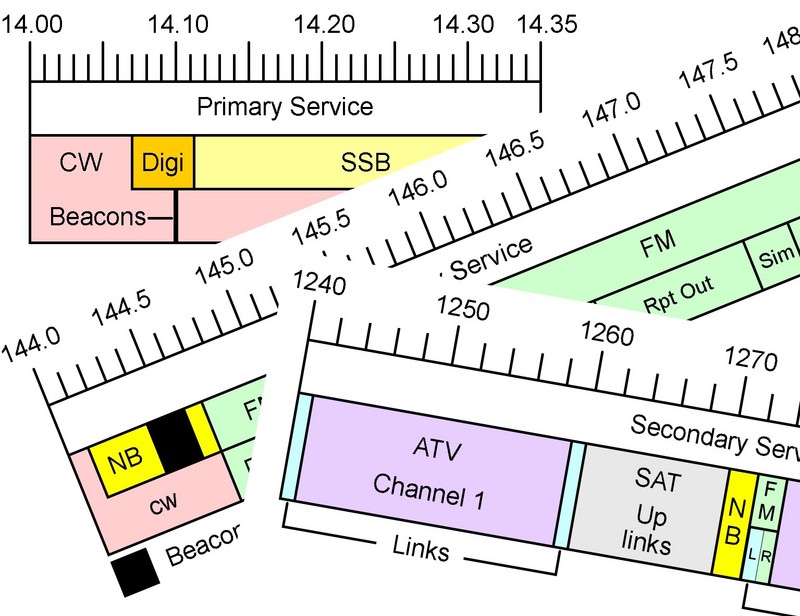
Bandplans


Band Plan Update

Band plan news

6 metre band plan

The 6 metre band plan has been reworded to clarify ACMA operating restrictions between 50 and 52 MHz.

Recommended IARU Region III centre frequencies for emergency operation

At its 2009 meeting, IARU Region III adopted the following frequencies as recommended emergency centre of activity frequencies: 3.600, 7.110, 14.300, 18.160 and 21.360 MHz. As an IARU member society, the WIA has adopted these recommended frequencies.

"Centre of Activity" frequencies are not spot frequencies. They are recommended as starting points for emergency traffic which may extend 5 kHz above or below the designated centre frequency.

Proposed band plan changes

6 Metre APRS

A dedicated simplex channel for APRS is to be established in the 6 metre band. The frequency proposed is 53.050 MHz.

23 cm D-Star simplex channel

It is proposed to extablish a national simplex channel for 23 cm simplex operation (as distinct from the single frequency D-Star repeater gateways operating above 1298 MHz). The suggested frequency is 1297.500 MHz, in the existing Digital Simplex band segment.

Recent band plan changes

IRLP and Echolink

Band plan changes during the past year include recommended frequencies for simplex IRLP and Echolink gateways:
 2 metres - 145.325, 145.350, 145.375 and 145.400
 70 cm - 439.150 and 439.175

D-Star Frequencies

To avoid co-channel interference between D-Star and analog FM operation, D-Star repeaters are being assigned to frequencies that are not used by FM repeaters.

The band plans also include details of recommended frequencies for simplex D-Star operation:
 2 metres - 145.125 MHz.
 70 cm - primary 438.900, secondary 439.8875 and 439.9125 (12.5 kHz spacing)
These recommended frequencies are subject to review as D-Star activity increases.

Revised CTCSS Standards

Changes have been made to the standard CTCSS tones to be used for repeater access and linking.

Our licence conditions require tone access for repeaters that are linked to repeaters in certain other bands, to prevent transmissions from being relayed on frequencies that the operators are not entitled to use. CTCSS is also used to activate selective linking or for interference protection.

The following CTCSS tones have been adopted for repeater access:
 91.5 Hz: For use with repeaters fitted with CTCSS for interference protection.
 141.3 or 146.2 Hz: To activate links to repeaters on other VHF/UHF bands.
 85.4 Hz: To activate links to other bands that some operators are not permitted to use.
The previously recommended 123 Hz tone is no longer recommended for future repeaters due to problems with false detecting.

LF Band

The band plans now include an interim plan for the 2200 metre (135.7 - 137.8 kHz) band.

Overseas band plan information

New Zealand: click this Link for band plan information from the NZART.
IARU Region I: click this Link to the IARU Region I web site.
IARU Region II: click this Link for details of the Region II MF and HF band plans.
IARU Region III: click this Link.

Files For Download

Latest version of the band plans - 7 January 2010
Australian Band Plans 100107.pdf


Page Last Updated: Saturday 26 December 2009 at 17:36 hours