Interference Hunting: Skills Every Radio Amateur Can Use
Date :
12 /
08 /
2026
Author :
Critical Comms, Rohde & Schwarz & WIA
Radio frequency interference is hardly a new problem for radio amateurs, but the rapidly growing number of electronic and wireless devices around us means finding unwanted signals is becoming an increasingly useful skill. An excellent recent article published by Critical Comms, An introduction to interference hunting, by Paul Denisowski and Peter Busch of Rohde & Schwarz, explains the principles, equipment and techniques used to identify and locate RF interference. The article defines interference in practical terms as RF energy that negatively affects the operation of a wireless system, whether it manifests as noise and unwanted audio on analogue systems or dropped connections and degraded performance on digital systems.
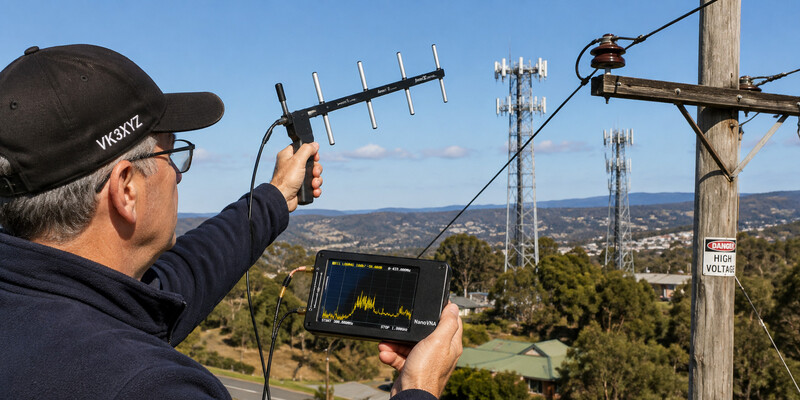
For radio amateurs, much of the methodology will seem reassuringly familiar. The process starts by establishing that interference really exists, examining its spectral characteristics and behaviour, then progressively narrowing down its location. Spectrum analysers (based on NanoVNAs) and monitoring receivers are valuable tools, but so too are portable receivers and directional antennas such as Yagis, log-periodics and dipoles. Spectrum and waterfall displays can reveal intermittent or frequency-varying interference, while observing patterns can provide important clues. An interfering signal that appears only at particular times, during certain activities or even during particular weather conditions may reveal considerably more about its source than its signal strength alone.
This has obvious application in the amateur shack. Modern homes can contain a formidable collection of potential RF noise generators, including switch-mode power supplies, solar installations, LED lighting, computers, networking equipment, appliances and other electronics. The Rohde & Schwarz material also distinguishes broad electrical noise from the generally narrower spurious emissions generated by electronic equipment. For amateurs faced with a mysterious increase in the noise floor, the professional interference-hunting approach provides a disciplined alternative to wandering around the neighbourhood with a handheld radio and increasingly suspicious opinions about everyone's solar inverter.
The full Critical Comms article is based on the more detailed Rohde & Schwarz white paper, which covers interference fundamentals, different sources, practical analysis and field techniques. Both are worthwhile reading for technically curious amateurs and clubs looking for a practical presentation, workshop or foxhunt-with-a-purpose activity. Full credit to Critical Comms web e-zine for publishing the article and to authors Paul Denisowski and Peter Busch and Rohde & Schwarz for the original technical material.
Read the Critical Comms article: An introduction to interference hunting Link
Read the original Rohde & Schwarz white paper Link
Page Last Updated: Tuesday, 11 Aug 2026 at 22:39 hours by Justin Giles-clark
Click Here To Return To Previous Page
|