Australian Radio Amateurs Invited to Help Sound the Ionosphere During the 2028 Total Solar Eclipse
Date :
04 /
08 /
2026
Author :
WIA, HAMSCI & David Kazdan, AD8Y
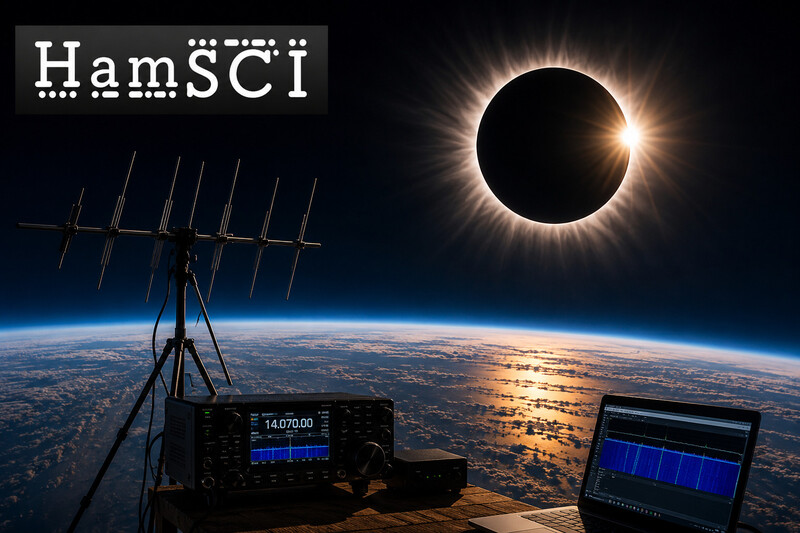
The Wireless Institute of Australia has received an early approach from the international Ham Radio Science Citizen Investigation, better known as HamSCI, about developing a major amateur radio ionospheric research experiment during the 22 July 2028 total solar eclipse.
The eclipse presents an extraordinary scientific opportunity. Its path of totality will cross Australia from the north-west to the south-east, pass through Sydney, continue across the Tasman Sea and cross New Zealand’s South Island. Sydney is expected to experience almost four minutes of totality, giving researchers and radio amateurs a rare natural laboratory stretching across thousands of kilometres.
What is HamSCI?
Link
HamSCI brings professional researchers, university students and radio amateurs together to use amateur radio as a distributed scientific instrument. Its eclipse experiments examine how the ionosphere responds when the Moon’s shadow temporarily reduces solar radiation and rapidly changes ionisation in the upper atmosphere.
During the 2017 and 2024 North American eclipses, HamSCI used amateur radio contacts, accurately timed signals and monitoring stations to observe changes in HF propagation and signal characteristics. NASA has described these activities as a way of using the eclipse as a natural laboratory, with radio amateurs producing large, geographically distributed datasets that researchers can analyse after the event.
The proposed Australian experiment follows work involving the US time and frequency station WWV, Canada’s CHU and other transmitters positioned near previous eclipse paths. HamSCI has also undertaken smaller experiments in Chile and the Falkland Islands and is preparing additional work involving stations in Spain and Iceland.
What could happen in Australia?
HamSCI researcher David Kazdan, AD8Y, from Case Western Reserve University, has proposed exploring an experimental radio path extending from south of Darwin to Sydney, potentially continuing to Fiordland in New Zealand.
The project could involve:
 fixed or portable transmitting stations on several amateur bands; fixed or portable transmitting stations on several amateur bands;
receiving stations positioned along and beyond the eclipse path;
accurately timed recordings of signal strength, Doppler shift and multipath effects;
specialised test signals developed by HamSCI researchers and students;
amateur radio clubs, universities and individual operators collecting observations before, during and after the eclipse; and
coordinated Australian, New Zealand and international research teams.
Recent HamSCI research has demonstrated that specially designed chirps and other audio waveforms transmitted using ordinary SSB amateur radio equipment can help identify changing propagation modes and estimate the virtual height of ionospheric layers. In other words, familiar amateur equipment can become part of a continent-scale scientific instrument, which is considerably more dignified than its usual role of facilitating arguments about audio quality.
Why begin planning now?
Although July 2028 may appear comfortably distant, an experiment of this scale will require significant preparation. Suitable propagation paths and frequencies must be modelled, transmitting and receiving sites identified, equipment tested, regulatory requirements considered, university and research partners engaged, and potential grant funding pursued.
HamSCI has already developed substantial experience through four eclipse campaigns. The Australian eclipse offers the prospect of a carefully designed multi-band experiment using several signal types and a wide network of receiving stations.
The project would also give Australian amateurs a valuable opportunity to demonstrate the scientific and educational role of the Amateur Service. It could involve experienced weak-signal operators, propagation specialists, clubs, students, universities, software developers, portable operators and amateurs willing to host or supervise receiving equipment.
Expressions of interest sought
The WIA is seeking expressions of interest from radio amateurs who may be willing to:
lead or coordinate the Australian, or VK, team;
join the project’s technical or scientific planning group;
provide suitable transmitting or receiving sites;
assist with equipment, software, timing, propagation analysis or data management;
establish links with universities, schools or research organisations; or
operate and support stations during the eclipse.
Those interested in leading the VK team or contributing to the project should contact the WIA National Office, outlining their amateur radio experience, technical interests, location and the role they may be able to perform.
This is a rare opportunity for Australian radio amateurs to contribute to genuine ionospheric research during one of the country’s most significant astronomical events. The Moon will supply the shadow. HamSCI will supply the science. Australia now needs the radio amateurs.
Page Last Updated: Monday, 03 Aug 2026 at 21:06 hours by Justin Giles-clark
Click Here To Return To Previous Page
|