Amateur Radio and Citizen Science: Helping Advance Science One Signal at a Time
Date :
08 /
08 /
2026
Author :
WIA
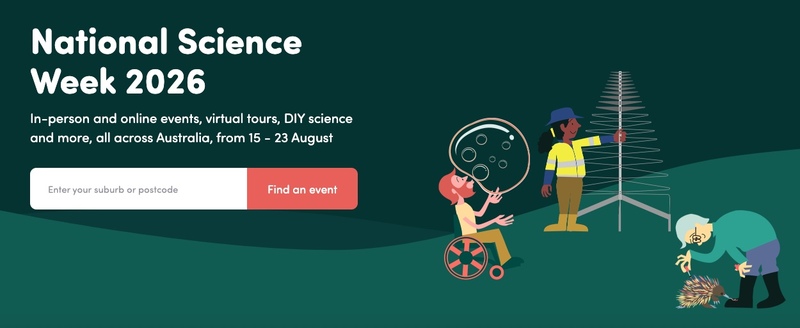
National Science Week, Australia's annual celebration of science and technology, will be held from 15 to 23 August 2026. Across the country, thousands of events will showcase how science improves our lives and how everyday Australians can become involved in scientific discovery. It is the perfect opportunity to recognise that amateur radio has been contributing to citizen science for more than a century.
While many people think amateur radio is simply about talking to other operators around the world, it has always been much more than that. Radio amateurs build equipment, conduct experiments, collect data and work alongside universities, research organisations and government agencies to better understand our world. Many amateurs are scientists, engineers, teachers, technicians and IT professionals in their working lives, while countless others make significant scientific contributions simply through curiosity, experimentation and a willingness to learn.
Across Australia and internationally, amateur radio operators are involved in an extraordinary range of citizen science activities. They monitor HF propagation and the changing ionosphere through projects such as HamSCI, receive weather satellite imagery from polar-orbiting satellites, track amateur satellites and CubeSats, contribute observations to meteor scatter research, experiment with microwave propagation, participate in weak-signal studies using WSPR, FT8 and Q65, and help develop new digital communications techniques. Others contribute to radio astronomy, environmental monitoring, high-altitude balloon projects, electronics design, software-defined radio development and emergency communications research.
Australia has a proud history of scientific leadership in radio. From the pioneering days of radio astronomy through to the Square Kilometre Array and modern satellite communications, Australian researchers have continually pushed the boundaries of radio science. Amateur radio complements this tradition by providing an accessible pathway for people of all ages to explore electronics, physics, mathematics, computing and engineering through practical, hands-on experimentation.
Recent examples demonstrate the growing role of amateurs in modern research. Australian schools continue to inspire students through ARISS contacts with astronauts aboard the International Space Station, while planning has already begun for a continent-wide amateur radio experiment during the 2028 total solar eclipse in partnership with the international HamSCI organisation. These projects show that amateur radio is not simply about communicating. It is about observing, measuring, experimenting and contributing real scientific data to international research.
National Science Week celebrates curiosity, discovery and innovation, values that have always been at the heart of amateur radio. Whether you are building an antenna, analysing propagation, decoding satellite telemetry or mentoring the next generation of operators, every experiment contributes to a broader understanding of radio science.
If your amateur radio club is holding a science-themed activity during National Science Week (15-23 August), consider registering it as an official National Science Week event and sharing the excitement of amateur radio with your local community.
More information about National Science Week, including events happening across Australia, is available at:
Link
Page Last Updated: Friday, 07 Aug 2026 at 21:37 hours by Justin Giles-clark
Click Here To Return To Previous Page
|