Before Australian Television Went Mainstream, Radio Amateurs Were Already There
Date :
15 /
09 /
2026
Author :
WIA & Peter Wolfenden VK3RV
On 16 September 1956, Bruce Gyngell famously welcomed Australians to commercial television on Sydney's TCN-9. But the history of Australian television did not begin with the commercial broadcasters. Long before television became a fixture in suburban lounge rooms, Australian experimenters and radio amateurs were already building transmitters, cameras and receivers and proving that pictures could indeed be sent through the air. The story was featured in the WIA National News Broadcast of 13 September 2026, drawing on the two-part Amateur Radio magazine series “Unsung pioneers of TV technology in Australia”, published in Issues 2 and 3 of 2022.
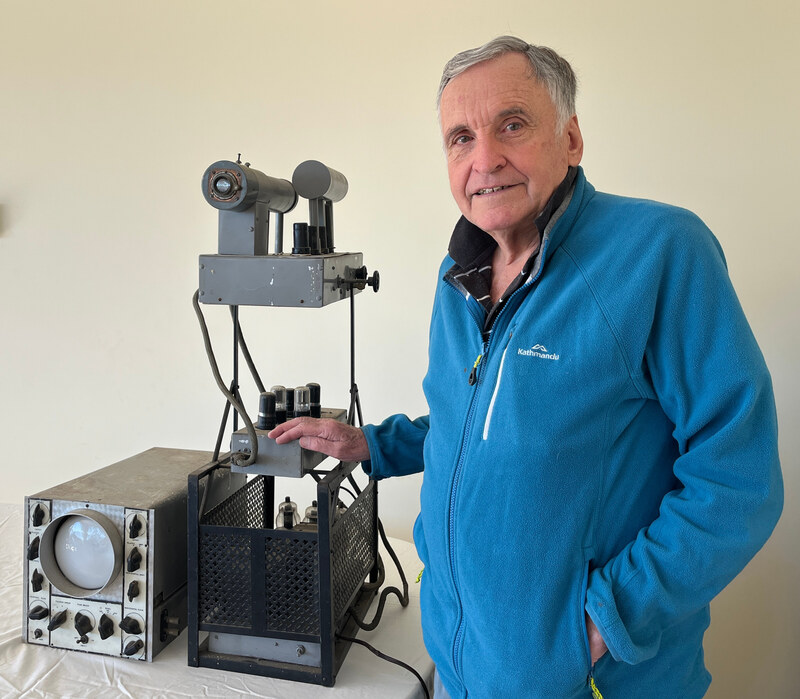
One of those pioneers was Len Moncur VK3LN/T in Melbourne. Len home-brewed television equipment and experimented with what was then called cathode-ray television. His wife Phyl Moncur became part of Australian television history when her image was transmitted during those pioneering amateur experiments. Their son is well-known Tasmanian amateur Rex Moncur VK7MO, and the connection with that extraordinary period of experimentation has not disappeared into a museum catalogue. Rex still holds some of his father's original equipment, including items shown in the photograph accompanying this story, preserving a tangible link with the days when television equipment was something inventive amateurs built rather than something bought in a box. The 2022 Amateur Radio feature also acknowledged Rex for providing family history that helped document this remarkable chapter.
Queensland has its own equally impressive claim to Australia's early television story. Experimental television was being undertaken in Brisbane years before regular commercial television. Thomas M. B. Elliott and Dr Val McDowall, associated with station VK4CM, conducted early television experiments from Brisbane's historic Wickham Terrace Windmill. Regular experimental broadcasts began in May 1934, initially using a 30-line system, and the Commonwealth subsequently granted special permission for experimental television operation. The system was later expanded to 180 lines. These broadcasts included news, still pictures and silent films, with only a tiny handful of receivers available to watch them.
Similar experimentation was underway elsewhere. Amateur and experimental television activities appeared in Sydney and Melbourne, while the development of television came at genuine risk to some pioneers. The history is a reminder that radio amateurs were not simply spectators during the development of electronic communications. They were among the people building, modifying, transmitting, receiving and experimenting with the technology before it became mainstream.
The full story is well worth revisiting in Amateur Radio magazine, Volume 90, Issues 2 and 3 of 2022, where WIA Historian Peter Wolfenden VK3RV documented the contributions of these largely unsung television pioneers. And thanks to Rex VK7MO, at least part of the Moncur family's original equipment has survived. The photograph accompanying this story provides a rare look at some of the hardware from a period when getting a face onto a screen required rather more ingenuity than opening an app and complaining about the Wi-Fi.
WIA National News Broadcasts - Link
Amateur Radio magazine – WIA - Link
ABC Archives – Early television broadcasting experiments in Brisbane - Link
Page Last Updated: Monday, 14 Sep 2026 at 20:52 hours by Justin Giles-clark
Click Here To Return To Previous Page
|