What Happens When the Sun Has a Bad Day?
Date :
24 /
09 /
2026
Author :
AIDR, NEMA & WIA
For radio amateurs, the Sun can be our best friend and our worst enemy. It can produce the ionisation that makes long-distance HF communication possible, then occasionally throw enough charged particles and radiation in our direction to make the bands behave as though someone has disconnected the antenna.
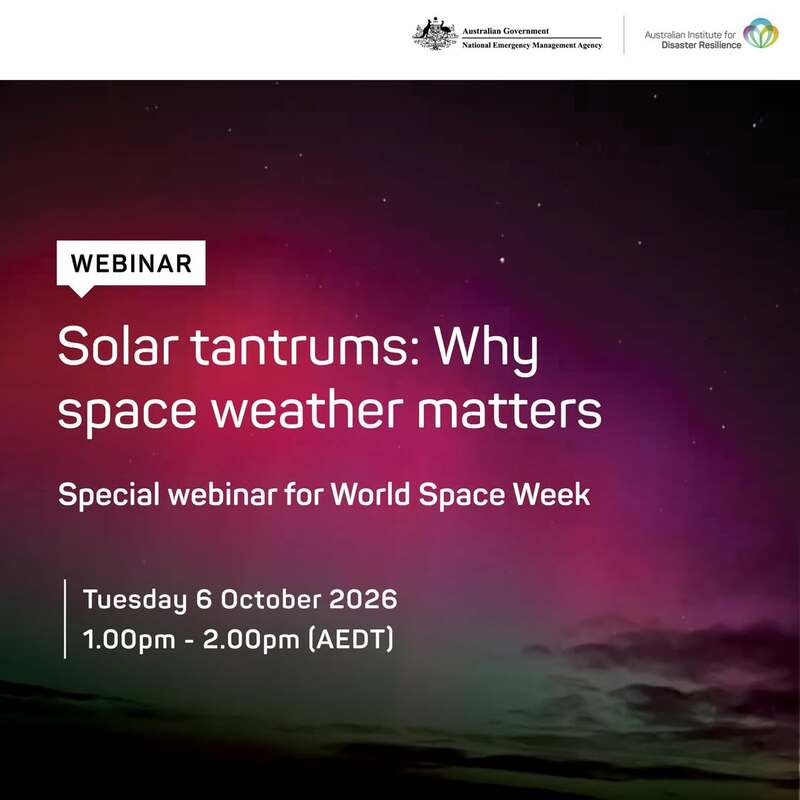
The Australian Institute for Disaster Resilience (AIDR) is presenting a free, beginner-friendly introduction to space weather and its real-world impacts on Earth, examining what happens when activity on the Sun begins affecting the technological systems on which modern society depends.
The session will explore how solar events can affect power systems, communications, satellite navigation, aviation, satellites and emergency management. An expert panel will explain the underlying science in accessible language, with no previous space-weather knowledge required.
Why should radio amateurs be interested?
Space weather is particularly relevant to the amateur radio community because the Sun and Earth's ionosphere are fundamental parts of our communications system. Solar flares, coronal mass ejections and geomagnetic disturbances can dramatically alter HF propagation, while solar activity can also produce radio blackouts, increased absorption and changes in the usable frequencies for long-distance communications.
The Australian Bureau of Meteorology's Australian Space Weather Forecasting Centre monitors solar and geophysical conditions and provides warnings and information for sectors including radio communications, satellite operations, aviation, navigation and power systems.
For amateurs involved with HF propagation, satellites, GNSS/GPS, weak-signal operation, propagation research, emergency communications or citizen science, understanding space weather can turn apparently mysterious changes in the bands into something rather more explainable. It also provides valuable context for organisations such as WICEN/EmComm, where communications resilience and the possible failure or degradation of conventional infrastructure are important considerations.
Space weather is also one of those areas where amateur radio provides a remarkably accessible citizen-science laboratory. Every HF operator observing sudden changes in propagation, noise, absorption or unusual openings is effectively observing the behaviour of the ionosphere in real time. Networks such as HamSCI take this further by using amateur radio observations and distributed stations to support scientific studies of the ionosphere and space weather.
So if you've ever wondered why 20 metres can suddenly disappear, why a geomagnetic storm can turn HF propagation upside down, or exactly what people mean when they start discussing K-index, solar flux and radio blackouts, this session should provide a useful introduction.
The event is free, designed for beginners and requires no previous knowledge of space weather.
AIDR: What Happens When the Sun Has a Bad Day? Information and Registration - Link
Bureau of Meteorology Australian Space Weather Forecasting Centre - Link
HamSCI: Ham Radio Science Citizen Investigation - Link
Page Last Updated: Thursday, 24 Sep 2026 at 08:44 hours by Justin Giles-clark
Click Here To Return To Previous Page
|