Where Will Your Signal Go? Explore the RSGB's Online HF Propagation Tools
Date :
04 /
10 /
2026
Author :
RSGB & WIA
Working out which HF band will provide the best path to another part of the world has traditionally involved propagation charts, solar data, experience and a certain amount of staring hopefully at the S-meter. The Radio Society of Great Britain (RSGB) offers a pair of free online propagation prediction tools that make the process considerably easier.
The tools grew from the propagation predictions published each month in RadCom. The RSGB recognised that printed predictions cannot account for the enormous differences between individual amateur stations, particularly operators using high-gain antennas, different power levels or sensitive digital modes such as FT8. The online tools allow amateurs to tailor predictions much more closely to their own stations.
Two Different Ways to Explore HF Propagation
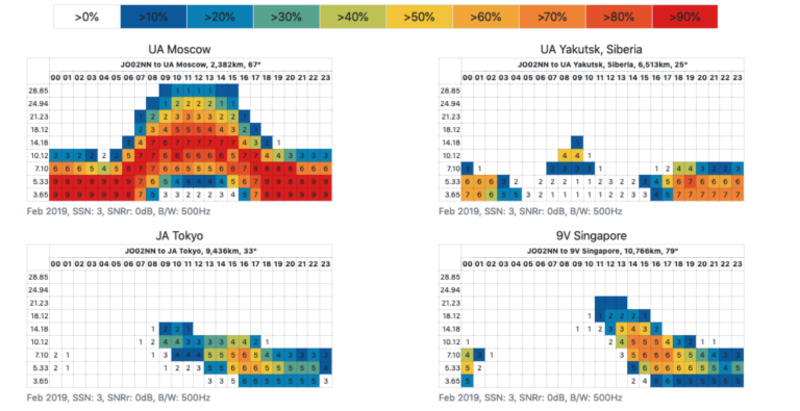
The first tool uses the well-established VOACAP propagation prediction engine. Developed for the RSGB application by Jari Perkiömäki OH6BG, it allows you to specify your location, operating mode, transmitter power and antenna gain across the amateur bands. It then produces coloured charts showing the predicted reliability of communication on each band and path.
The second is the newer ITURHFPROP RadCom tool, produced by programmer and RSGB Propagation Studies Committee member James Watson HZ1JW. It provides hour-by-hour monthly median predictions between your Maidenhead Locator and 28 locations around the world, including short and long-path calculations where appropriate.
This tool goes considerably further than simply suggesting a band. Operators can select SSB, CW, FT8 and other modes, choose from different antennas at each end of the path and specify the expected local noise level. Results show Basic Circuit Reliability (BCR) along with predicted median received signal strength expressed as S-levels. Predictions below -121 dBm, approximately S1, are not displayed.
You can also print the month's predictions to a PDF, making it particularly handy when planning a contest, DX activity, portable operation or simply deciding when it might be worth getting out of bed for that elusive overseas contact.
Useful for Australian Amateurs
For Australian operators, propagation prediction can be particularly valuable because so many desirable paths involve very long distances. Understanding how time of day, frequency, mode, antenna performance and path reliability interact can help identify when 20 metres might outperform 40 metres, when the higher bands could open, or when a weak-signal mode might make a marginal path workable.
These aren't guarantees. The ionosphere retains its traditional refusal to read prediction charts. But used alongside current solar and geomagnetic information, beacon observations, WSPR, FT8 activity and simply listening to the bands, propagation modelling can help amateurs make much more informed operating decisions.
The RSGB also provides a substantial collection of supporting propagation resources covering HF, LF/VLF, VHF, Sporadic-E, aurora, meteor scatter, microwave propagation, ionograms, solar and geophysical information, greyline propagation and noise-floor studies. Radio Society of Great Britain
Whether you're chasing DX, contesting, experimenting with antennas, planning a portable activation or simply trying to understand why yesterday's booming 10-metre path has apparently vanished from the face of the Earth, the RSGB propagation tools are worth bookmarking.
RSGB RadCom Online Propagation Prediction Tools - Link
VOACAP RadCom Propagation Tool - Link
Page Last Updated: Saturday, 03 Oct 2026 at 20:26 hours by Justin Giles-clark
Click Here To Return To Previous Page
|