Tasmania Takes a Leading Role in Space Surveillance: New Opportunities for Amateur Radio and Satellite Experimentation
Date :
24 /
10 /
2026
Author :
UTAS & WIA
The University of Tasmania has secured a significant role in a new $20 million national space research initiative, bringing exciting opportunities for satellite tracking, radio science, software-defined radio and the next generation of Australian space researchers.
The University of Tasmania (UTAS) has announced its involvement in the new Australian Research Council (ARC) Training Centre for Space Domain Awareness, a five-year initiative designed to improve Australia's ability to monitor satellites, space debris and other objects orbiting Earth.
The Centre will receive $5 million in ARC funding, with contributions from participating universities and industry partners bringing its total value to approximately $20 million.
Led by the University of Western Australia, in partnership with the University of Tasmania and UNSW Canberra, the Centre will involve 22 national and international partner organisations.
For Australia's amateur radio community, particularly those interested in amateur satellites, software-defined radio (SDR), radio astronomy and citizen science, this development highlights the growing intersection between professional space research and the technologies radio amateurs have been experimenting with for decades.
Tasmania's Growing Role in Space Science
According to UTAS, the new Centre will bring PhD researchers and a postdoctoral researcher to Tasmania, helping develop mission-control capabilities and coordinate space-monitoring operations.
Research Space Scientist Dr Guifré Molera Calvés, from the University's School of Natural Sciences, is part of the Tasmanian research team.
The project will build on the University's existing strengths in radio astronomy, space science and ground-based monitoring, while bringing together expertise in data analysis, Antarctic research, international law and governance.
The Tasmanian team also includes Adjunct Professor Tony Press and Professor Jeffrey McGee, whose expertise will contribute to understanding the legal, environmental and international governance challenges associated with increasing activity in space.
Researchers will collaborate with more than ten industry partners across Australia, Finland, Japan, the United Kingdom and the United States.
Why Space Domain Awareness Matters
Earth orbit is becoming increasingly congested.
Thousands of operational satellites now share space with retired spacecraft, discarded rocket components and fragments of orbital debris.
The challenge is not simply detecting these objects, but accurately determining their positions, trajectories and potential collision risks.
Space Domain Awareness combines information from ground-based sensors, optical telescopes, radar, radio observations and orbital modelling to develop a clearer picture of activity in space.
The new Centre will integrate data from sensors across Australia to improve the monitoring and understanding of the orbital environment.
Where Amateur Radio Fits In
For many radio amateurs, the technologies involved in satellite tracking and space monitoring will sound remarkably familiar.
Amateur radio operators have been experimenting with satellite communications since the earliest days of the space age.
Today, enthusiasts routinely use relatively inexpensive equipment to receive signals from satellites, calculate orbital passes, decode telemetry and experiment with weak-signal communications.
There are several areas where amateur radio experience and space research intersect:
1. Satellite Tracking and Orbital Prediction
Radio amateurs routinely use orbital elements and tracking software to predict satellite passes, Doppler shifts and antenna pointing requirements.
These are foundational skills for understanding the movement of objects in Earth orbit.
2. Software-Defined Radio and Signal Processing
Affordable SDR receivers have made satellite reception and experimentation accessible to a much wider audience.
Amateurs can use SDR technology to investigate satellite transmissions, analyse signals, compensate for Doppler shift and decode telemetry.
3. Amateur Satellite Ground Stations
Building a ground station introduces practical experience in antennas, low-noise amplifiers, receivers, rotators, tracking software and digital communications.
These are valuable learning opportunities for students, radio clubs and aspiring space engineers.
4. Citizen Science and Collaborative Observations
Amateur radio operators can contribute to appropriate citizen-science projects through coordinated observations, signal measurements, telemetry reception and data analysis.
The international amateur satellite community already demonstrates the value of distributed receiving stations and shared observations.
5. Radio Astronomy and Weak-Signal Experimentation
Radio astronomy and amateur radio share important technical interests, including sensitive receivers, low-noise systems, frequency stability, antenna design and interference management.
The University's established expertise in radio astronomy provides an especially interesting connection between professional research and amateur experimentation.
An Opportunity for Australian Amateur Radio Clubs
The new ARC Training Centre creates an opportunity to consider how amateur radio clubs might support greater interest in space science, STEM education and satellite experimentation.
Possible club activities include:
Demonstrations of receiving amateur satellite telemetry using SDR receivers.
Workshops on satellite tracking, orbital prediction and Doppler correction.
Building simple satellite receiving stations and antennas.
Exploring publicly available satellite data and telemetry.
Introducing students to radio-frequency engineering, digital communications and space science.
Participating in established amateur satellite and citizen-science projects.
These activities offer practical ways to introduce young people and newcomers to amateur radio while connecting the hobby with contemporary scientific and engineering challenges.
Importantly, the University has not announced a formal amateur radio participation program within the Centre. These are potential areas for future collaboration and community engagement, rather than confirmed Centre activities.
The WIA: Connecting Amateur Radio With Science
The Wireless Institute of Australia recognises the important role amateur radio can play in connecting practical experimentation with science, technology, engineering and mathematics.
From satellite communications and SDR to radio astronomy and distributed scientific observations, amateur radio provides an accessible pathway for people to explore technologies used in professional research.
The WIA's recent presentation at the SDR2026 conference in Adelaide, From Spectrum to Science, highlighted the potential for amateur radio to act as a bridge between experimenters, educators, researchers and citizen-science initiatives.
Developments such as the new ARC Training Centre reinforce the relevance of that approach.
From the Shack to Space Science
The University of Tasmania's involvement in this national initiative is welcome news for Australia's scientific and engineering community.
It also provides a timely reminder that amateur radio is far more than a communications hobby.
The same curiosity that encourages an amateur to build a satellite antenna, decode a telemetry beacon or experiment with an SDR receiver can lead towards careers and research in radio engineering, space science and satellite systems.
The WIA congratulates the University of Tasmania and its research partners on this important initiative and looks forward to opportunities for amateur radio to continue supporting experimentation, education and citizen science.
Further Information and Credits
University of Tasmania: University Secures Key Role in $5m ARC Space Centre (20 October 2026)
Link
University of Tasmania
Link
Australian Research Council
Link
AMSAT: Amateur Radio in Space
Link
SatNOGS: Open-Source Satellite Ground Station Network
Link
International Amateur Radio Union
Link
Wireless Institute of Australia
Link
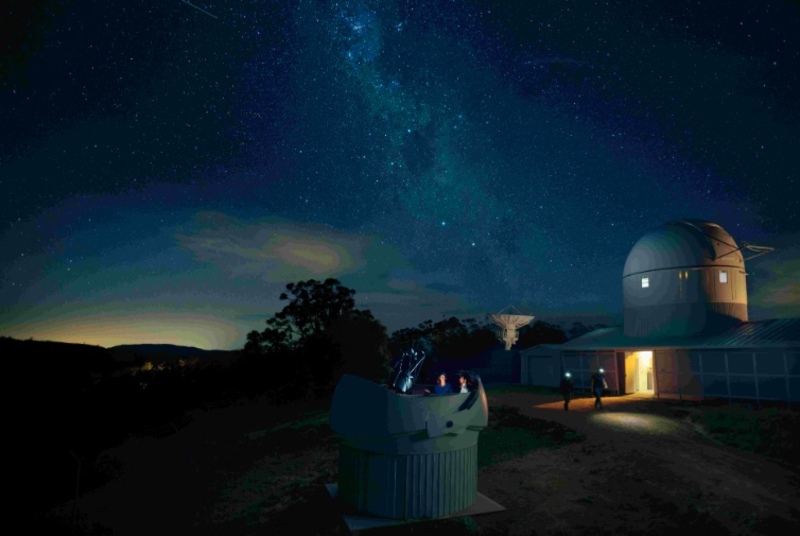
Image sourced from the UTAS Media Release.
Source acknowledgement: The project announcement, funding, institutional partnerships and research details are credited to the University of Tasmania, published 20 October 2026. The discussion of amateur radio, satellite experimentation, SDR and potential citizen-science opportunities is additional WIA commentary and does not imply an existing partnership or participation arrangement with the ARC Training Centre.
Page Last Updated: Friday, 23 Oct 2026 at 21:10 hours by Justin Giles-clark
Click Here To Return To Previous Page
|