The Moon Is Calling! ARRL International EME Contest Open to the World
Date :
26 /
10 /
2026
Author :
ARRL & WIA
31 October–1 November and 28–29 November 2026 | 50 MHz to 1296 MHz
Who needs an ionosphere when you've got the Moon?
The American Radio Relay League (ARRL) is inviting radio amateurs around the world to take part in its 2026 International Earth-Moon-Earth (EME) Contest, one of amateur radio's most technically challenging and fascinating operating events.
And despite being organised by the ARRL in the United States, this is very much an international contest.
After all, approximately half the world can see the Moon at any given moment. Why shouldn't Australian radio amateurs join in?
What Is Earth-Moon-Earth Communication?
Earth-Moon-Earth, commonly known as EME or Moonbounce, involves transmitting a radio signal towards the Moon and receiving the extremely weak signal reflected from its surface back on Earth.
With the Moon approximately 384,400 kilometres away on average, a signal must travel roughly 770,000 kilometres for a return echo to Earth.
That journey takes around 2.5 seconds, making EME one of the most extraordinary examples of long-distance amateur radio communication.
The enormous path loss means successful EME operation requires careful attention to antenna performance, receiver sensitivity, frequency stability, Doppler shift and signal processing.
Modern digital modes, particularly Q65 using WSJT-X, have made EME more accessible to experimenters who may not have the enormous antenna arrays traditionally associated with Moonbounce.
The 2026 ARRL International EME Contest
The contest aims to encourage radio amateurs to make as many contacts as possible using signals reflected from the Moon.
The first two contest weekends, covering 2.3 GHz and higher frequencies, were held in August and September.
The remaining two weekends cover 50 MHz through to 1296 MHz:
31 October–1 November 2026
28–29 November 2026
Each contest period runs for 48 hours, from 0000 UTC Saturday to 2359 UTC Sunday.
For Australian operators in New South Wales, Victoria, Tasmania and the ACT, that translates to 11:00 am Saturday through to 10:59 am Monday AEDT.
The contest is open to eligible amateur radio operators worldwide, including those in Australia.
Bands, Modes and Scoring
The October and November weekends cover authorised amateur frequencies from 50 MHz to 1296 MHz, subject to each operator's national licensing conditions.
Permitted operating modes include CW, phone and digital modes.
The exchange is based on four-character Maidenhead grid squares, although analog stations may use an alternative mutually understood signal report where conditions make exchanging grid squares impractical.
Each completed EME contact earns 100 points, with additional scoring based on the number of different grid squares worked on each band.
Stations may be worked once per band for contest credit, regardless of mode.
Why Australian Amateurs Should Get Involved
Australian EME operators have a proud history of experimentation on VHF, UHF and microwave frequencies.
The ARRL contest provides an opportunity to make international contacts, test station performance, compare antenna systems and experiment with weak-signal techniques.
The beauty of EME is that the Moon provides a common reflector for stations separated by enormous distances.
When two stations can both see the Moon, they may have an opportunity to communicate even when ordinary terrestrial propagation is impossible.
Of course, visibility alone does not guarantee a contact. Moon elevation, path loss, polarisation, Doppler shift, equipment performance and local noise conditions all play a role.
But that's what makes EME so interesting!
You Don't Need to Be a Big-Gun EME Station to Participate
Even if you don't have a complete Moonbounce station, the contest is an excellent opportunity to explore EME technology.
Radio amateurs and clubs can use the event to:
Experiment with low-noise receivers and SDR technology.
Explore WSJT-X and Q65 weak-signal decoding.
Investigate Moon tracking and Doppler compensation.
Compare antenna gain, system noise temperature and receiving performance.
Attempt to receive established EME stations.
Learn from experienced Moonbounce operators.
Receiving EME signals can be a worthwhile technical achievement in itself, even if you're not yet ready to complete a two-way contact.
For clubs, the contest offers an excellent opportunity for a practical technical activity involving antennas, propagation, software and signal processing.
An International Contest With a Universal Reflector
One of amateur radio's great strengths is its ability to bring together experimenters across national boundaries.
EME takes that concept to another level.
Instead of relying on terrestrial repeaters, satellites or the ionosphere, operators use a natural reflector nearly 400,000 kilometres away.
The Moon doesn't recognise national borders, licensing jurisdictions or contest organisers.
The ARRL might organise the contest, but the Moon is available to everyone who can see it!
The WIA encourages Australian radio amateurs with EME capability to participate, and those interested in Moonbounce to use the contest as an opportunity to learn more about this fascinating aspect of amateur radio.
Contest Information and Resources
ARRL International EME Contest: Dates and Rules
Link
Complete ARRL EME Contest Rules (PDF)
Link
ARRL EME Contest Log Submission
Link
WSJT-X Weak-Signal Software
Link
ARRL Contest Portal
Link
Wireless Institute of Australia
Link
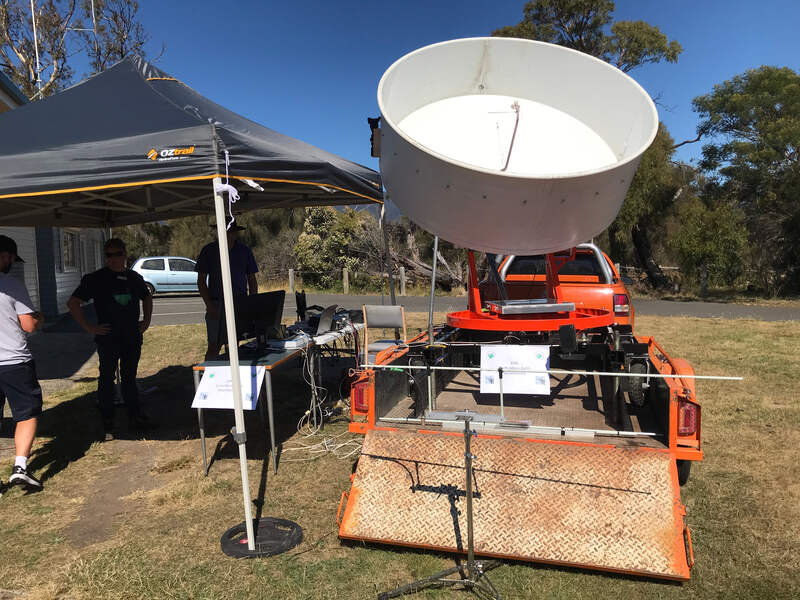
Image is from a REAST Open Day and is showcasing Richard VK7ZBX's 1.8m EME Dish.
Log submission deadline: 29 December 2026 at 2359 UTC.
Source acknowledgement: Contest dates, rules and participation details are credited to the American Radio Relay League (ARRL). Technical commentary on EME experimentation and its relevance to Australian radio amateurs is additional WIA commentary.
Page Last Updated: Sunday, 25 Oct 2026 at 17:58 hours by Justin Giles-clark
Click Here To Return To Previous Page
|