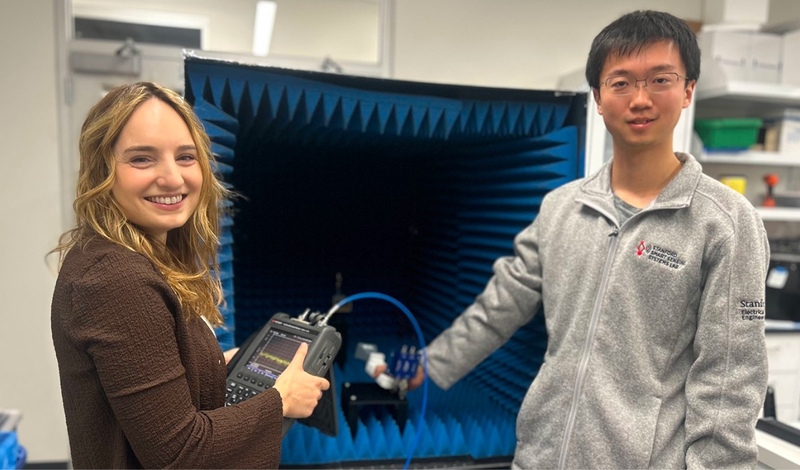
Communicating With Noise! Stanford Researchers Turn Radio Static Into a Wireless Signal
Date :
03 /
11 /
2026
Author :
PNAS & WIA
What if you could communicate wirelessly without generating a conventional radio signal, using the electrical noise that's already present? Researchers at Stanford University have demonstrated a fascinating new approach that could reduce the energy needed for wireless communications by up to 1,000 times.
The technique, known as thermal noise communication, uses the natural electrical noise produced by the random movement of electrons in conductors.
Radio amateurs know this phenomenon as thermal noise, or Johnson-Nyquist noise. It's the familiar background hiss that becomes particularly noticeable when listening to weak signals.
But instead of treating this noise as something to overcome, Stanford researchers have found a way to use it to carry information.
How Does It Work?
Conventional radio transmitters generate an electrical signal and radiate electromagnetic energy through an antenna.
Thermal noise communication takes a different approach.
The transmitter switches between two circuit states:
- Absorbing: One state absorbs some of the naturally occurring background noise.
- Reflecting: The other state reflects that noise towards the receiver.
The receiver amplifies and analyses the resulting changes, interpreting the two states as digital ones and zeros.
In other words, information is carried by changing how existing noise behaves, rather than generating a conventional modulated carrier.
The researchers developed a mathematical model of the communication channel and used it to improve data transfer rates by a factor of 100.
Their experiments also demonstrated energy consumption up to 1,000 times lower than conventional RF transmission under the conditions studied.
Why Is This Important?
The technology could be particularly valuable where power consumption and unwanted electromagnetic emissions are major concerns.
Potential applications include:
- Medical devices: Low-power wireless communication where battery life and electromagnetic compatibility are important.
- Radio astronomy: Communications equipment that minimises interference with extremely sensitive receiving systems.
- Environmental sensors: Small, battery-powered monitoring devices that need to operate for long periods.
- Scientific instruments: Wireless data transfer in locations where conventional transmitters could interfere with measurements.
The research has been published in the scientific journal Proceedings of the National Academy of Sciences (PNAS).
What Does This Mean for Amateur Radio?
For radio amateurs, the research offers an intriguing example of how familiar radio-frequency principles can be used in completely new ways.
Thermal noise is normally something we try to minimise through low-noise amplifiers, careful receiver design, antenna improvements and signal processing.
Now researchers are exploring how that same noise can become a communications resource.
The work has interesting connections with Software Defined Radio (SDR), weak-signal detection, receiver noise figures, impedance matching and digital signal processing.
It also raises possibilities for future experimentation with extremely low-power communications and unconventional modulation techniques.
There are important limitations. This is experimental research, not a replacement for conventional HF, VHF or UHF communications. Practical range, data rates, receiver complexity and operating conditions will determine where the technique becomes useful.
Nevertheless, it demonstrates an important principle familiar to radio amateurs: sometimes the next communications breakthrough comes from reconsidering something we've taken for granted.
For more than a century, radio experimenters have worked to overcome noise. Stanford's researchers have asked a different question: what if we could communicate with it?
Further Reading
Stanford University
Link
Stanford Engineering Research News
Link
Proceedings of the National Academy of Sciences (PNAS)
Link
Wireless Institute of Australia
Link
Image sourced from the Stanford Article.
Source acknowledgement: Research conducted by Stanford University and published in PNAS. The discussion of amateur radio, SDR and weak-signal experimentation is additional technical commentary.
Page Last Updated: Monday, 02 Nov 2026 at 20:22 hours by Justin Giles-clark
Click Here To Return To Previous Page
|