QuickSmith: A Free Online Smith Chart Tool for Amateur Radio Experimenters
Date :
04 /
11 /
2026
Author :
QuickSmith & WIA
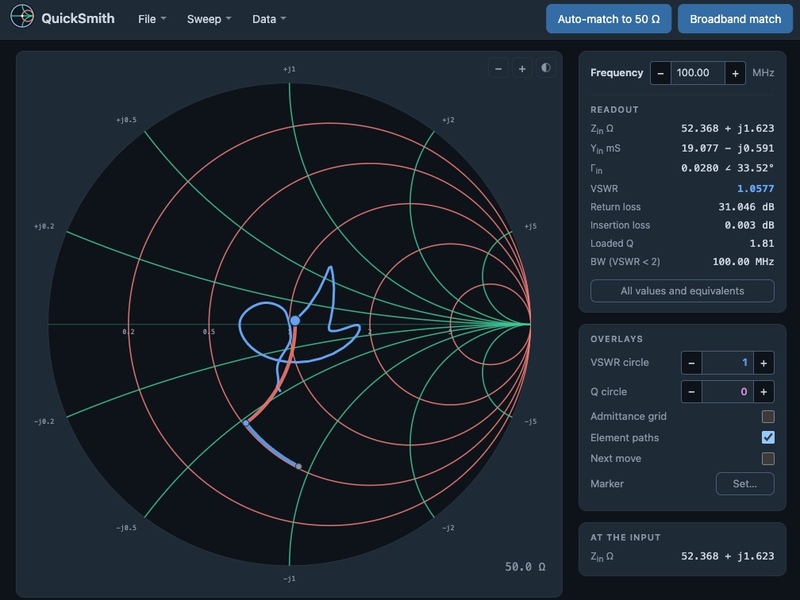
Ever wondered what happens to your antenna impedance when you add a capacitor, inductor or length of transmission line? QuickSmith is a free online tool that lets radio amateurs explore RF impedance matching using an interactive Smith chart.
For anyone interested in antennas, matching networks, RF filters or homebrew radio equipment, QuickSmith offers a practical way to experiment with circuit designs before reaching for the soldering iron.
Available at https://quicksmith.online/, the browser-based application provides an interactive Smith chart and circuit simulator that can be used to investigate how different components affect impedance and matching performance.
What Can QuickSmith Do?
QuickSmith allows users to construct matching networks using resistors, capacitors, inductors and transmission-line elements, then observe the results on a Smith chart.
Features include:
Interactive Smith chart: Visualise complex impedance and how matching components change it.
Impedance matching: Experiment with circuits to transform an antenna or load impedance towards 50 ohms.
VSWR and return loss: See how well a proposed network matches the source and load.
Frequency sweeps: Investigate how a circuit behaves across a range of frequencies.
Insertion loss and loaded Q: Explore the performance and bandwidth of matching networks.
Measurement imports: Work with supported network-analyser measurement data, including Touchstone files.
Transmission-line calculations: Explore the effects of coaxial cable and microstrip transmission lines.
Save and share: Save designs and generate links to share with other experimenters.
The application also includes guided examples and help resources, making it useful for operators who are still learning how to interpret a Smith chart.
Why Is It Useful for Amateur Radio?
A Smith chart is one of the most useful tools in RF engineering, but it can initially look rather intimidating.
QuickSmith makes the concepts easier to understand by allowing operators to change circuit components and immediately see the effect on impedance, VSWR and frequency response.
For example, you could use the application to explore an L-network for matching an antenna, investigate the effects of adding a transmission-line section or examine how component values influence matching bandwidth.
It also provides an excellent companion to a NanoVNA or other vector network analyser, allowing measured impedance data to become the starting point for further experimentation.
An Excellent Resource for Club Training
QuickSmith could be particularly valuable for WIA-affiliated clubs running technical workshops, antenna construction sessions or amateur radio training.
Instead of simply explaining impedance matching on a whiteboard, instructors can demonstrate how inductors, capacitors and transmission lines move impedance around the Smith chart.
Members can experiment with different matching arrangements and compare their calculations with real measurements.
The software is also useful for more experienced experimenters designing RF matching networks, filters and amplifier circuits.
Of course, simulation is only the starting point. Real components have losses, tolerances, voltage and current limits, and other characteristics that must be considered before building and transmitting through a circuit.
QuickSmith provides another excellent example of how free online tools are making RF engineering more accessible to amateur radio operators.
Whether you're learning about impedance matching for the first time or developing your next homebrew project, it's well worth exploring.
Links and Further Information
QuickSmith: Free Online Smith Chart and RF Circuit Simulator
Link
The DXZone: QuickSmith Review
Link
Wireless Institute of Australia
Link
Source acknowledgement: QuickSmith and its developer, Nathan Iyer. Additional information from The DXZone and Everything RF. Amateur radio applications and club training suggestions are WIA commentary.
Page Last Updated: Tuesday, 03 Nov 2026 at 20:57 hours by Justin Giles-clark
Click Here To Return To Previous Page
|