|
|
Beyond Moonbounce: Radio Amateurs Bounce a Message Off Venus!
Date :
06 /
11 /
2026
Author :
CAMRAS & WIA
Forget Earth-Moon-Earth for a moment. A team of radio amateurs working with the historic Dwingeloo Radio Telescope in the Netherlands has taken planetary radio experimentation to another level, successfully bouncing a digital message off Venus and decoding its return to Earth!
Most radio amateurs are familiar with Earth-Moon-Earth (EME), or Moonbounce, where signals are reflected from the Moon to make contacts over enormous distances.
But what about using another planet as the reflector?
That's exactly what the team at the Dwingeloo Radio Telescope has achieved using Earth-Venus-Earth (EVE) communications.
And the message they successfully recovered was wonderfully appropriate:
“VENUS ECHO”
A Radio Signal's Extraordinary Journey
Venus is tens of millions of kilometres from Earth, making the technical challenges vastly greater than those involved in conventional Moonbounce.
During the experiment, the radio signal travelled more than 26 million miles (approximately 42 million kilometres) each way, requiring a round trip of around five minutes at the speed of light.
Compare that with EME, where the Moon is approximately 384,400 kilometres away and a radio signal completes its return journey in about 2.5 seconds.
The EVE experiment involved an extraordinary round-trip path loss of approximately 500 dB.
That means the reflected signal arriving back at Earth was almost unimaginably weak.
The Challenge of Receiving an Echo From Venus
Unlike the Moon, Venus presents some particularly difficult problems for radar-style communications.
The planet's rotation and the different velocities of reflecting regions across its surface can produce Doppler spreading, distributing the returning signal's energy across a range of frequencies.
This makes detecting and decoding a weak reflected signal considerably more challenging.
To overcome these difficulties, the Dwingeloo team used sophisticated signal-processing techniques and combined repeated echoes.
It reportedly took approximately 40 minutes of received echoes to reconstruct the ten-character message.
The result is a remarkable demonstration of what can be achieved through patient experimentation, advanced digital signal processing and highly capable radio equipment.
The Dwingeloo Radio Telescope and Amateur Radio
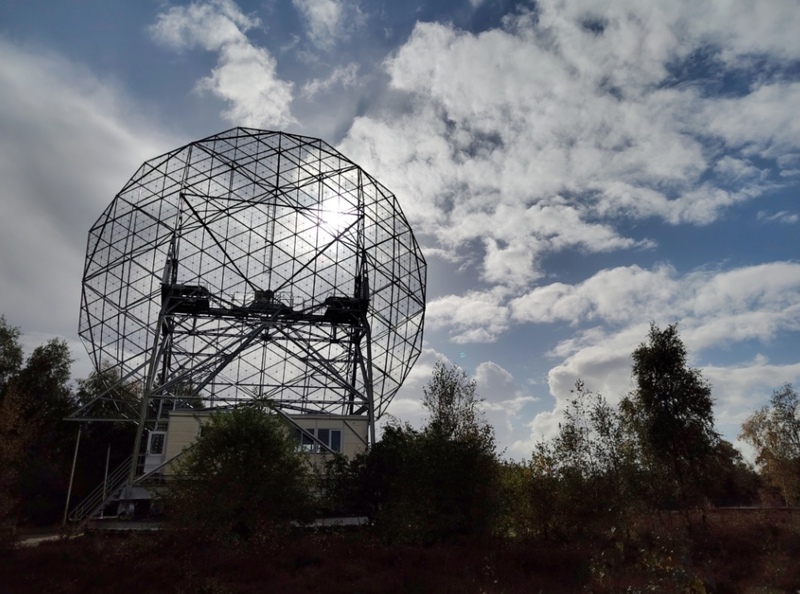
The Dwingeloo Radio Telescope, located in the Netherlands, is a historic 25-metre radio astronomy dish that has found a remarkable second life supporting amateur radio and educational experimentation.
The telescope is operated by the CAMRAS Foundation, a volunteer organisation dedicated to preserving and using the facility for radio astronomy, amateur radio and educational projects.
The telescope has become internationally recognised for its contributions to amateur radio experimentation, including Moonbounce and reception of spacecraft signals.
The Venus experiment demonstrates how professional-scale radio astronomy infrastructure can be combined with the curiosity, expertise and determination of amateur radio experimenters.
Why This Matters to Amateur Radio
The achievement is far more than a novelty.
It demonstrates several important principles that are central to modern amateur radio experimentation:
Weak-signal communications: Recovering information from signals buried deep in noise.
Digital signal processing: Combining and analysing repeated transmissions to improve detectability.
Doppler compensation: Understanding and correcting frequency changes caused by relative motion.
Precision frequency and timing: Maintaining stable references over exceptionally long propagation paths.
Antenna engineering: Using high-gain systems to transmit and receive extremely weak signals.
Scientific experimentation: Developing techniques, testing predictions and learning from the results.
These are the same broad disciplines explored by radio amateurs working with EME, Software Defined Radio, microwave communications, satellite tracking and digital weak-signal modes.
While Earth-Venus-Earth communication requires equipment and facilities far beyond those available to most individual operators, the underlying principles are familiar to amateur radio experimenters.
Amateur Radio Continues to Push the Boundaries
The successful decoding of a message reflected from Venus represents a major step beyond simply detecting a planetary radar echo.
It is a powerful example of the continuing contribution that amateur radio can make to technical innovation and scientific experimentation.
For Australian radio amateurs, it reinforces the value of encouraging activities such as EME, microwave experimentation, SDR development, weak-signal communications and partnerships with universities and research organisations.
From bouncing signals off the Moon to recovering a message reflected from Venus, amateur radio continues to demonstrate that experimentation has no shortage of new frontiers.
The next time someone asks what radio amateurs actually do, here's another remarkable example!
Further Information
CAMRAS Foundation: Dwingeloo Radio Telescope
Link
Dwingeloo Radio Telescope
Link
AMSAT: Amateur Radio Satellite Experimentation
Link
International Amateur Radio Union
Link
Wireless Institute of Australia
Link
Image sourced from the CAMRAS Website.
Source acknowledgement: The experiment is attributed to the amateur radio team associated with the Dwingeloo Radio Telescope and the CAMRAS Foundation in the Netherlands. Technical figures and details of the decoded message are drawn from the supplied account of the experiment.
Page Last Updated: Friday, 06 Nov 2026 at 22:00 hours by Justin Giles-clark
Click Here To Return To Previous Page
|
|