The Future is in the Room: Tassie Ham-E-Con Challenges Amateur Radio to Rethink Its Future
Date :
20 /
11 /
2026
Author :
REAST & WIA
Are we facing a recruitment problem, a relevance problem, or a culture problem?
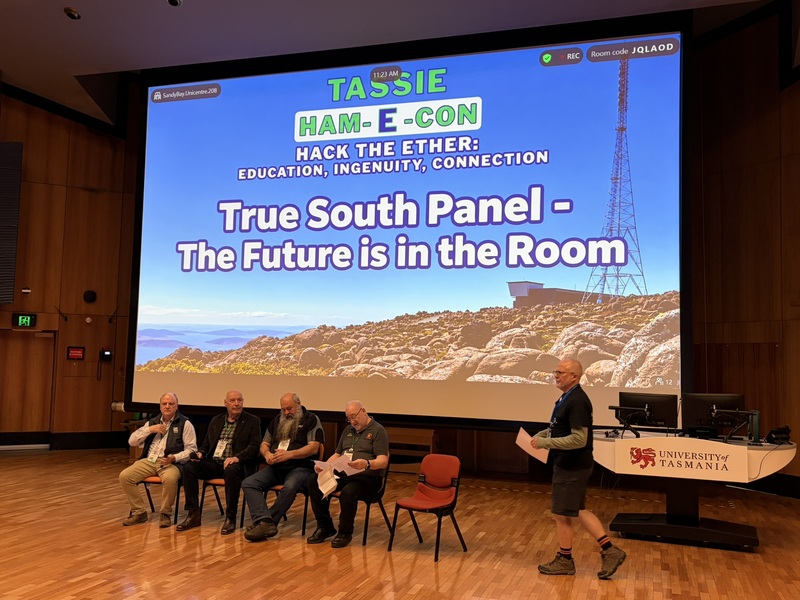
That was one of the thought-provoking questions emerging from the True South: The Future is in the Room panel forum at Tassie Ham-E-Con 2026, held at the University of Tasmania in Hobart on 7–8 November.
Organised by the Radio and Electronics Association of Southern Tasmania (REAST), the conference brought together radio amateurs from across Australia and New Zealand under the theme Hack the Ether: Education, Ingenuity, Connection.
The True South forum, part of the conference's fourth stream, Hack the Future: Leadership and Purpose, challenged participants to consider what amateur radio must preserve, what needs to change and what we should be creating for the future.
And the audience responses delivered some important messages for amateur radio clubs, national organisations and individual operators alike.
Attracting people is the challenge. Keeping them engaged is the opportunity.
In a Slido poll asking participants to identify the biggest challenge facing amateur radio, 52% nominated attracting and retaining new participants.
Club culture, relevance and inclusion followed at 17%, with education and emerging technologies at 13%. Leadership and organisational renewal, and spectrum, regulation and public relevance, each received 9%.
But perhaps the most revealing result came when participants were asked what amateur radio should actually prioritise.
The leading response, with 33% of votes, was making clubs more welcoming and activity-focused.
Strengthening advocacy, partnerships and public relevance followed at 22%, embracing SDR, AI and emerging technologies at 17%, developing the next generation of leaders at 15%, and modernising education and learning pathways at 13%.
These results raise an uncomfortable but necessary question.
Are we spending too much time trying to attract people into amateur radio and not enough time thinking about what happens when they arrive?
What happens after someone gets their licence?
The forum's written questions and comments provided further insight.
Participants raised concerns about younger people struggling to find their place, newcomers becoming overwhelmed by the enormous range of amateur radio activities, and some clubs remaining attached to traditional approaches that may no longer meet everyone's expectations.
Other responses highlighted the impact of gatekeeping, resistance to new ideas, exclusionary behaviour and the difficulty of encouraging new leadership.
One participant asked how new licensees could be guided through the bewildering range of possibilities, from HF and repeaters to DMR, FT8 and other digital technologies.
Another questioned how amateur radio could attract people under 25, while others challenged whether traditional club structures were sufficiently welcoming and relevant.
These comments do not describe every club. Across Australia, many amateur radio clubs are doing outstanding work in education, experimentation, mentoring and community engagement.
But they do raise an important question for all of us:
When someone walks through the door of our club for the first time, do they discover a community of opportunity, or a community of established routines?
And perhaps more importantly, what happens when they return for the second or third visit?
Technology matters, but people matter more
The conference celebrated the extraordinary opportunities emerging through software-defined radio, artificial intelligence, digital communications, STEM education and citizen science.
These technologies provide exciting new ways to experiment with the electromagnetic spectrum and connect amateur radio with broader scientific and technical communities.
However, the True South results suggest that technological innovation alone will not secure amateur radio's future.
We also need innovation in how we organise, educate, mentor, collaborate and welcome people.
Could amateur radio clubs become more like collaborative makerspaces, where people gather around projects, experimentation and shared learning?
Could we create better pathways from obtaining a licence to becoming an active and confident operator?
Could younger amateurs be encouraged to lead projects and shape activities rather than simply inherit existing traditions?
And could national organisations and local clubs work more closely together to share resources, successful approaches and opportunities?
These are questions worth asking, even when the answers challenge established assumptions.
From conversation to action
The True South findings offer useful insights for the Wireless Institute of Australia and its affiliated clubs.
They also align with several areas of the WIA's 2026–2027 Strategic Priorities, particularly education, club support, collaboration and improved engagement with the wider community.
Potential areas for further work include developing practical resources for welcoming clubs, improving mentoring and newcomer pathways, strengthening volunteer leadership, sharing successful club activities and supporting experimentation with emerging technologies.
The findings are not a statistically representative survey of all Australian radio amateurs, nor do they constitute a formal national policy position. They do, however, provide a valuable starting point for further discussion and practical experimentation.
The WIA believes there is considerable value in encouraging affiliated clubs to share their experiences, particularly examples of what is working to attract, welcome and retain active participants.
The future is in the room
Perhaps the most important message from Tassie Ham-E-Con is that amateur radio's future will not be determined by technology, spectrum access or organisational structures alone.
It will also be determined by the culture we create, the opportunities we provide and the willingness of experienced amateurs to encourage the next generation.
Amateur radio has always been built on curiosity, experimentation, ingenuity and a willingness to try something different.
Those qualities are just as relevant to the way we organise our clubs and communities as they are to the equipment on our benches.
The future of amateur radio will not be secured simply by attracting more people. It will be secured by creating an amateur radio community in which more people want to participate, contribute and stay.
The challenge from True South is now for all of us.
What will your club do differently in 2027?
Find out more about Tassie Ham-E-Con and the work of REAST:
Link
Read the WIA's 2026–2027 Strategic Priorities:
Link
Acknowledgement: The WIA thanks the Radio and Electronics Association of Southern Tasmania (REAST), the True South panellists and all conference participants who contributed to this important conversation about amateur radio's future.
Page Last Updated: Thursday, 19 Nov 2026 at 22:16 hours by Justin Giles-clark
Click Here To Return To Previous Page
|