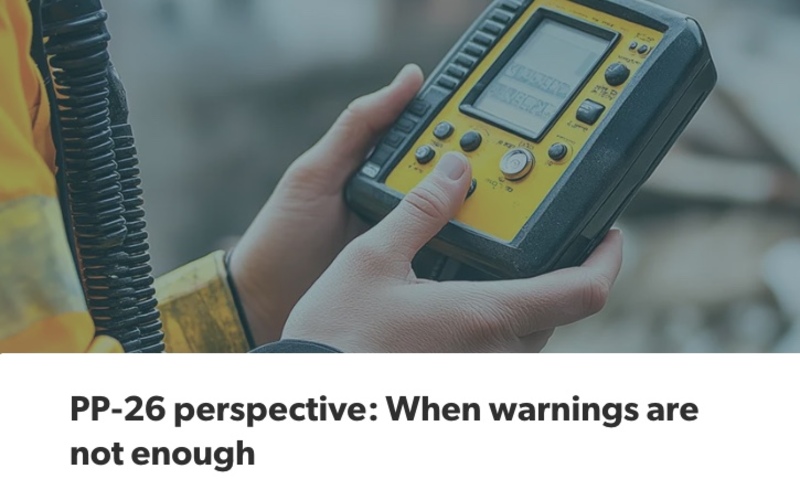
When Warnings Are Not Enough: When All Else Fails, There Is Amateur Radio
Date :
27 /
11 /
2026
Author :
ITU & WIA
In an increasingly connected world, what happens when the very communications networks we depend upon are no longer available?
An article published by the International Telecommunication Union (ITU) on 25 November 2026, titled “PP-26 perspective: When warnings are not enough”, highlights the importance of resilient communications infrastructure before, during and after natural disasters.
Written by Daniella Esi Darlington, Co-Founder and CEO of Alleina AI and a member of the ITU Secretary-General's Youth Advisory Board, the article explores the challenges of delivering timely emergency warnings and maintaining communications when disaster strikes.
For the amateur radio community, it reinforces a message that has remained relevant for more than a century: when all else fails, there is amateur radio.
When Communications Networks Fail
The ITU article highlights the experience of Hurricane Beryl in July 2024, which disabled fixed and mobile communications across five southern islands of Saint Vincent and the Grenadines. For weeks, a single communications terminal provided their connection to the outside world.
The article also identifies that approximately 173 million people worldwide remain beyond the reach of early warning messages.
While advances in telecommunications, satellite technology, artificial intelligence and emergency alerting systems are improving disaster preparedness, the resilience of communications networks remains a significant challenge.
Delivering a warning is only part of the equation. Maintaining communications throughout an emergency and supporting the subsequent recovery are equally important.
Amateur Radio: An Independent Communications Capability
Here in Australia, we understand the vulnerability of communications infrastructure through our experiences with:
Bushfires, destroying telecommunications infrastructure and interrupting electricity supplies.
Floods, isolating communities and damaging terrestrial communications networks.
Cyclones and severe storms, disrupting mobile services, power distribution and transport infrastructure.
Space weather events, potentially disrupting satellite communications, GNSS navigation, electrical grids and HF propagation.
Other major infrastructure failures, including extended power outages and telecommunications network disruptions.
Amateur radio offers an additional layer of communications resilience through its ability to establish independent, decentralised radio networks.
Using portable equipment, independent power supplies, temporary antennas and a range of frequencies and operating modes, suitably trained radio amateurs can establish communications without necessarily relying on the internet, mobile phone towers or commercial telecommunications infrastructure.
No single communications technology is immune to every type of disruption. The diversity of amateur radio's frequencies, equipment and operating techniques is therefore one of its greatest strengths.
The Value of Trained Radio Amateurs
Amateur radio's emergency communications capability is not simply about having access to radio equipment. It is about having a geographically distributed community of people with the technical knowledge, practical experience and operating skills to establish communications under challenging circumstances.
Across Australia, organisations such as the Wireless Institute Civil Emergency Network (WICEN) and other amateur radio emergency communications groups help maintain this capability through training, exercises, technical experimentation and cooperation with emergency management organisations.
Activities such as portable operation, field days, emergency communications exercises, digital messaging and experimentation with independent power supplies all contribute to developing these valuable skills.
Amateur radio is not a replacement for professional emergency services or commercial telecommunications networks. Rather, it provides a complementary communications capability that can be deployed when required and in coordination with the relevant authorities.
Building Communications Resilience Before Disaster Strikes
The ITU's work on emergency telecommunications provides an important opportunity to recognise the wider public benefit of amateur radio.
Maintaining access to appropriate radio spectrum, encouraging amateur radio education, supporting emergency communications training and strengthening partnerships with emergency management organisations are all important investments in community resilience.
Amateur radio is more than a recreational activity. It is a community of trained communicators, technical experimenters and volunteers with the potential to contribute when conventional communications systems are compromised.
The time to develop emergency communications capability is not when disaster strikes. It is well before it happens.
When all else fails, there is amateur radio.
Further Information
ITU News: PP-26 perspective – When warnings are not enough:
Link
United Nations Early Warnings for All Initiative:
Link
International Amateur Radio Union (IARU):
Link
Australian Bureau of Meteorology Space Weather Services:
Link
WICEN: Link
Wireless Institute of Australia:
Link
Images sourced from the ITU Story.
Source acknowledgement: Daniella Esi Darlington, Co-Founder and CEO of Alleina AI and member of the ITU Secretary-General's Youth Advisory Board, “PP-26 perspective: When warnings are not enough”, ITU News, 25 November 2026. The Australian amateur radio and emergency communications perspective has been added to highlight the relevance of the article to our community.
Page Last Updated: Friday, 27 Nov 2026 at 11:07 hours by Justin Giles-clark
Click Here To Return To Previous Page
|